

Role of analytics in business: Drive growth in 2026

Over 80% of enterprises will adopt generative AI or AI-enabled analytics by 2026, fundamentally reshaping how organizations compete and operate. Business leaders now face an urgent challenge: how to leverage analytics effectively amid rapid technological evolution. This guide reveals practical strategies to harness analytics for measurable growth, operational efficiency, and smarter decision-making that directly impact your bottom line.
Table of Contents
- Introduction To Business Analytics
- The Transformative Impact Of AI On Business Analytics
- Building Trust In AI-Driven Analytics
- Leveraging Real-Time And Edge Analytics For Operational Excellence
- Overcoming Organizational Silos For Analytics Success
- Driving Business Impact With Outcome-Driven Analytics
- Transform Your Business With TechMoths Insights
Key takeaways
| Point | Details |
|---|---|
| Analytics powers competitive advantage | Data-driven decisions and operational agility separate market leaders from followers |
| AI amplifies capabilities but demands trust | Transparency and human oversight are essential to maximize AI analytics value |
| Real-time insights enable rapid action | Edge analytics reduces latency by 50%, empowering instant responses to opportunities |
| Cross-functional collaboration drives results | Breaking down silos and democratizing analytics unlocks organization-wide innovation |
| Outcome focus maximizes ROI | Aligning analytics to business goals generates measurable impact beyond mere reporting |
Introduction to business analytics
Business analytics transforms raw data into strategic advantages through four distinct categories. Descriptive analytics answers “what happened” by summarizing historical performance. Diagnostic analytics reveals “why it happened” by identifying root causes and patterns. Predictive analytics forecasts “what will happen” using statistical models and machine learning. Prescriptive analytics recommends “what should we do” by simulating outcomes and optimizing decisions.
Analytics has evolved from descriptive to prescriptive, playing a key role in modern business strategy. Organizations once relied on static monthly reports that looked backward. Today’s systems provide dynamic, forward-looking insights integrated directly into strategic planning and daily operations.
Successful analytics implementations share four core components:
- Data collection from diverse sources including CRM systems, IoT devices, social media, and transaction platforms
- Processing infrastructure that cleanses, transforms, and stores data for analysis
- Modeling capabilities using statistical methods, machine learning algorithms, and visualization tools
- Insight delivery mechanisms translating complex findings into clear, actionable recommendations
Modern analytics platforms combine these elements to create continuous feedback loops. Leaders query systems, receive insights, take action, and measure results in compressed timeframes. This cycle accelerates learning and adaptation, turning data into a genuine competitive weapon rather than a passive resource.
The role of data analytics business extends beyond reporting to actively shaping strategy. Organizations embedding analytics into core processes outperform peers by identifying opportunities faster, responding to threats more decisively, and allocating resources with greater precision.
The transformative impact of AI on business analytics
Agentic AI represents a quantum leap in analytics automation. These systems autonomously explore datasets, identify anomalies, generate hypotheses, and surface insights without explicit human prompting. Unlike traditional analytics requiring analysts to ask specific questions, agentic AI proactively discovers patterns humans might miss.
This autonomy frees skilled professionals from routine tasks. Analysts spend less time cleaning data or building standard reports and more time interpreting findings and advising on strategic decisions. AI handles the mechanical work while humans provide context, judgment, and creativity.
Generative AI adoption grows rapidly as natural language interfaces democratize access. Business users now query databases conversationally, receiving visualizations and narratives without writing code. This accessibility breaks down technical barriers that historically confined analytics to specialized teams.
Key AI-powered capabilities transforming analytics include:
- Natural language processing enabling conversational queries and automated insight narratives
- Automated machine learning selecting optimal algorithms and tuning parameters without data science expertise
- Anomaly detection continuously monitoring metrics and alerting stakeholders to unexpected patterns
- Scenario modeling simulating multiple futures to evaluate strategic options
The role of AI in business analytics extends beyond efficiency gains to fundamentally expanding what’s possible. Organizations discover relationships too complex for manual analysis, predict outcomes with unprecedented accuracy, and respond to changing conditions in real time.

Pro Tip: When adopting AI analytics, prioritize solutions offering explainability and human in the loop features to maintain control. Transparent systems that show their reasoning build confidence and enable productive collaboration between humans and machines.
Building trust in AI-driven analytics
Despite AI’s power, only 10% of data practitioners express confidence in AI-generated insights due to hallucinations and black box issues. This trust gap threatens adoption and limits value realization. AI models sometimes generate plausible-sounding but incorrect outputs, misleading decision makers who lack tools to verify accuracy.
The black box problem compounds trust challenges. Complex neural networks produce recommendations without explaining their reasoning. Business leaders hesitate to act on advice they cannot understand or validate, especially for high-stakes decisions with significant financial or reputational consequences.
Building trust requires deliberate strategies addressing transparency and verification:
- Interpretable AI models using techniques like SHAP values or attention mechanisms to show which factors drove predictions
- Transparent documentation of data sources, algorithm choices, and model limitations
- Human in the loop workflows requiring expert review before implementing AI recommendations
- Validation processes comparing AI outputs against known benchmarks or alternative methods
- Gradual deployment starting with low-risk applications to build track records
Common pitfalls that erode trust include over-reliance without oversight and failure to update models as conditions change. Organizations treating AI-generated content as infallible experience costly errors when models encounter scenarios outside their training data.
Successful implementations balance automation with human judgment. AI handles scale and speed while domain experts provide context and catch errors. This partnership approach maximizes both efficiency and accuracy, building confidence through consistent, explainable results.
Avoiding mistakes common in AI startups like insufficient testing or ignoring edge cases applies equally to analytics adoption. Rigorous validation, continuous monitoring, and honest acknowledgment of limitations create sustainable trust.
Leveraging real-time and edge analytics for operational excellence
Real-time analytics processes data instantly as it’s generated, eliminating the delays inherent in traditional batch processing. Edge analytics reduces latency by up to 50% by performing computations at or near data sources rather than sending everything to centralized servers.
This architecture delivers multiple technical advantages. Reduced latency enables immediate responses to events like equipment failures or customer inquiries. Lower bandwidth consumption cuts costs by transmitting only relevant insights rather than raw data. Enhanced privacy keeps sensitive information local rather than exposing it during transmission.
| Dimension | Traditional Batch Analytics | Real-Time Edge Analytics |
|---|---|---|
| Latency | Hours to days | Milliseconds to seconds |
| Data Volume | Complete historical datasets | Filtered, relevant streams |
| Infrastructure Cost | High centralized processing | Distributed, lower per-node |
| Response Speed | Retrospective analysis | Immediate action |
| Privacy Risk | Data transmitted centrally | Processing at source |
Manufacturing organizations deploy edge analytics for predictive maintenance. Sensors on production equipment detect vibration patterns indicating imminent failures. Local processing triggers alerts and initiates corrective action before breakdowns occur, preventing costly downtime and production losses.
Healthcare providers use real-time analytics for continuous patient monitoring. Wearable devices track vital signs, detect anomalies, and alert medical staff instantly. This vigilance catches deteriorating conditions early, enabling interventions that improve outcomes and reduce complications.
Operational benefits extend across industries:
- Faster decisions capitalizing on fleeting opportunities or preventing losses
- Reduced downtime through proactive maintenance and rapid issue resolution
- Enhanced customer experience via personalized, context-aware interactions
- Improved resource allocation based on current rather than historical conditions
- Greater agility responding to market shifts or competitive moves
Pro Tip: Start with pilot projects focusing on critical processes to test edge analytics benefits before broader deployment. Choose applications where latency reduction creates clear value, measure results rigorously, and use successes to build momentum for expansion.
Overcoming organizational silos for analytics success
Data silos fragment customer insights and slow decision making. When marketing, sales, and service departments maintain separate systems, no one sees the complete customer journey. Analytics teams waste time reconciling inconsistent definitions and battling for access rather than generating insights.
95% of customer experience leaders invest or plan to invest in data integration technology, emphasizing unified data importance. Integrated platforms connect disparate sources, creating single sources of truth that enable holistic analysis and consistent reporting.
Common obstacles to integration include:
- Siloed ownership where departments protect data as power rather than sharing as assets
- Inconsistent definitions with different teams measuring the same concepts differently
- Lack of collaborative culture where success metrics focus on departmental rather than enterprise goals
- Technical debt from legacy systems designed for isolation rather than integration
Addressing these challenges requires both technology and organizational change. Data integration platforms provide technical infrastructure for connecting systems. Equally important are governance frameworks establishing common definitions, access policies, and quality standards.
Strategies for breaking down silos:
- Create cross-functional teams with representatives from each department working toward shared objectives
- Implement self-service analytics empowering business users to explore data without IT gatekeepers
- Standardize data governance establishing clear ownership, quality measures, and security protocols
- Align incentives rewarding collaboration and enterprise outcomes rather than just departmental metrics
Leaders play critical roles fostering collaboration. Executives must champion data sharing, model collaborative behavior, and remove barriers preventing cross-functional work. Middle managers need authority to break down walls and resources to build bridges.
Enterprise analytics creates business strategy when insights flow freely across boundaries. Organizations achieving integration see faster time to insight, more comprehensive understanding of customers, and better coordination of activities toward strategic goals.
Driving business impact with outcome-driven analytics
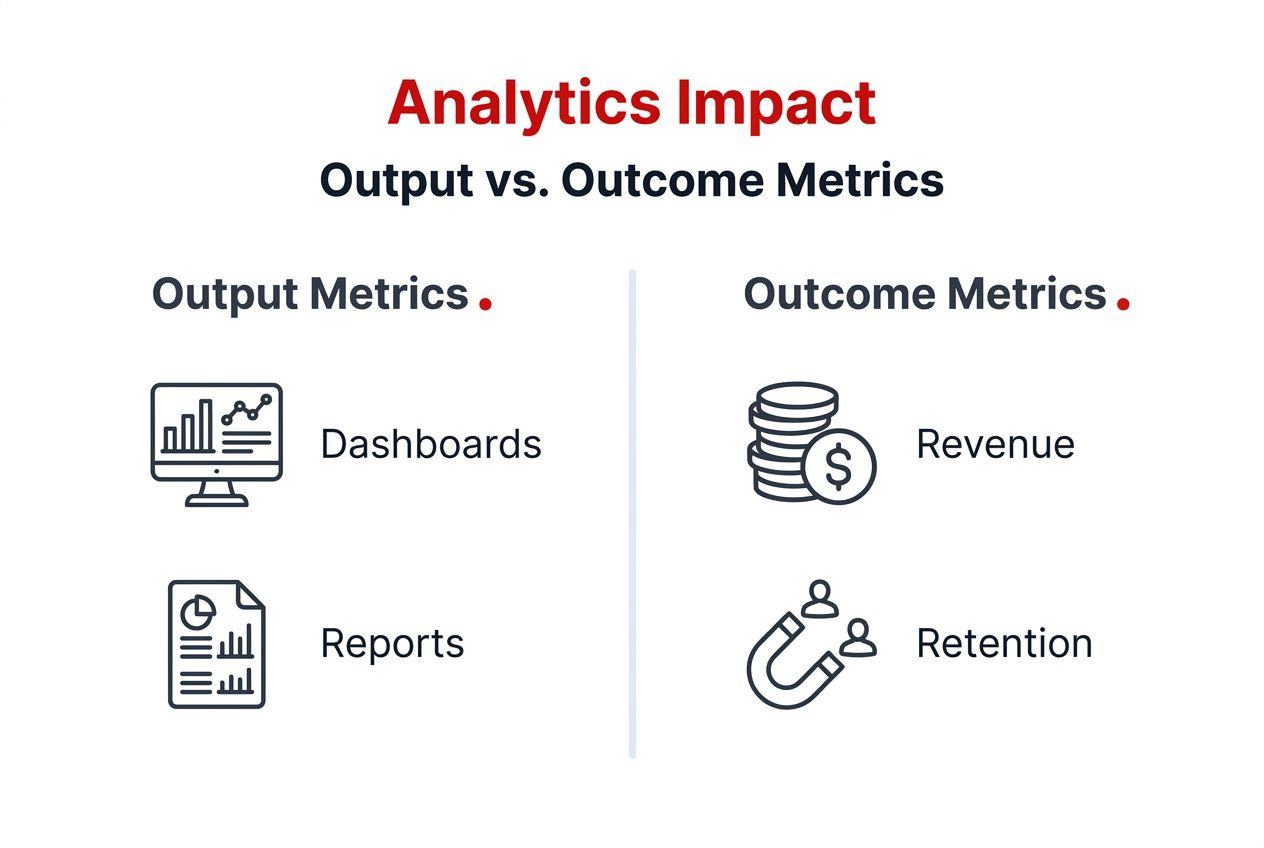
Output metrics like reports generated or dashboards created measure activity without capturing value. Outcome metrics like revenue growth, cost savings, or customer retention directly reflect business results. The shift from outputs to outcomes ensures analytics investments deliver measurable returns.
Outcome-driven alignment enhances analytics relevance by focusing on measurable business impact rather than just outputs. Organizations adopting this mindset design initiatives around specific goals, track progress against those goals, and adjust tactics based on results.
| Aspect | Output-Driven Analytics | Outcome-Driven Analytics |
|---|---|---|
| Primary Focus | Activity and deliverables | Business results and value |
| Success Metrics | Reports created, users trained | Revenue increased, costs reduced |
| Stakeholder Engagement | Periodic updates | Continuous collaboration |
| Resource Allocation | Spread across many projects | Concentrated on high-impact initiatives |
| ROI Visibility | Difficult to demonstrate | Clear and measurable |
Benefits of outcome focus include:
- Better strategic alignment connecting analytics work directly to business priorities
- Clearer ROI justifying investments and sustaining organizational support
| Improved prioritization focusing resources on highest-value opportunities - Enhanced accountability with explicit targets and transparent progress tracking
Data-driven insights influence business initiatives when tied to outcomes. Marketing teams optimize campaigns based on customer lifetime value rather than just click-through rates. Operations managers reduce waste by tracking total cost rather than just labor hours. Product teams prioritize features driving retention rather than just usage.
Business analysts evolve into strategic partners rather than report generators. They work alongside executives identifying opportunities, designing experiments, interpreting results, and recommending actions. This elevation requires analysts to develop business acumen complementing their technical skills.
Enterprise analytics creates business strategy when measurements align with objectives. Organizations sustain analytics programs by demonstrating tangible value, building credibility through results, and continuously improving based on feedback.
Transform your business with TechMoths insights
Navigating the analytics landscape requires staying current with emerging trends and proven strategies. TechMoths delivers comprehensive guides helping business leaders understand technologies, avoid common pitfalls, and implement solutions that drive measurable results.
Our platform covers the full spectrum from foundational concepts to advanced implementations. Whether you’re exploring AI integration, building cross-functional analytics capabilities, or measuring business impact, you’ll find actionable frameworks and real-world examples. We translate complex technical topics into practical guidance tailored for decision makers focused on growth and operational excellence. Visit TechMoths today to access resources that accelerate your analytics journey and competitive advantage.
FAQ
What is the primary role of analytics in modern business?
Analytics transforms data into competitive advantages by enabling faster, smarter decisions grounded in evidence rather than intuition. It reveals customer preferences, optimizes operations, and predicts future trends with measurable accuracy.
How does AI enhance business analytics capabilities?
AI automates routine analysis, discovers complex patterns humans miss, and democratizes access through natural language interfaces. It amplifies analyst productivity while extending insights to non-technical users across organizations.
Why is trust in AI analytics still limited?
Only 10% of practitioners fully trust AI-generated insights due to occasional hallucinations and black box models that don’t explain their reasoning. Building confidence requires transparent methods, human oversight, and rigorous validation processes.
What makes real-time analytics valuable for operations?
Real-time and edge analytics reduce decision latency by up to 50%, enabling immediate responses to equipment failures, customer needs, or market shifts. Faster reaction times prevent losses and capitalize on fleeting opportunities.
How do outcome-driven metrics improve analytics ROI?
Focusing on business outcomes like revenue growth rather than activity outputs ensures analytics investments deliver measurable value. This alignment clarifies priorities, justifies resources, and sustains organizational support through demonstrated impact.
